
The Sins We Never Commit

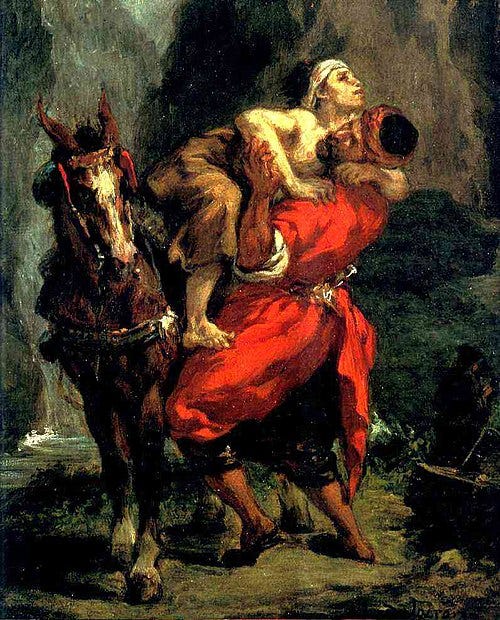
(Image: The Good Samaritan, by Eugène Delacroix)
One of the most searching moments in the Holy Communion service occurs before many worshippers have even settled into the rhythm of the liturgy.
Together, kneeling before Almighty God, we confess:
“We have left undone those things which we ought to have done; and we have done those things which we ought not to have done.”
Most Christians readily understand the second half of that confession. We know what it means to commit sin. We know what it means to lie, to lust, to gossip, to harbor bitterness, or to act in ways contrary to God’s commandments.
The first half, however, is often overlooked.
“We have left undone those things which we ought to have done.”
These are the sins we never commit.
The acts of mercy never shown. The truth never spoken. The courage never displayed. The prayers never offered. The neighbor never helped. The witness never given.
Scripture repeatedly warns that God judges not only the evil we perform, but also the good we neglect.
The tiny book of Obadiah provides a striking example.
The prophet delivers God’s judgment upon Edom, the descendants of Esau. When Jerusalem fell under attack, Edom did not come to her aid. Instead, the Edomites stood by and watched. Worse, they rejoiced in Judah’s calamity and eventually participated in the plunder.
Yet before their active participation came their passive indifference.
God condemns them because they stood aside while their brothers suffered.
“In the day that thou stoodest on the other side...” (Obadiah 11)
That phrase should trouble every Christian.
The Edomites may have convinced themselves that they were not responsible. They had not initiated the attack. They had not marched the armies against Jerusalem. They were merely observers.
But in God’s eyes they were not innocent spectators. Their refusal to act became part of their guilt.
The same principle appears throughout Scripture.
In the Parable of the Good Samaritan, the priest and Levite did not rob the wounded traveler. They did not beat him. They did not leave him half dead beside the road.
They simply walked away.
Their sin was not what they did. Their sin was what they failed to do.
Likewise, in our Lord’s description of the Final Judgment in Matthew 25, those condemned are not charged with murder, theft, or adultery.
Instead, Christ says:
“I was an hungred, and ye gave me no meat: I was thirsty, and ye gave me no drink.” (Matthew 25:42)
Their condemnation arose from neglect.
They failed to feed.
They failed to clothe.
They failed to visit.
They failed to care.
The Apostle James expresses the principle with brutal clarity:
“Therefore to him that knoweth to do good, and doeth it not, to him it is sin.” (James 4:17)
That verse destroys many of our excuses.
We often evaluate ourselves by asking, “What wrong have I done?”
Scripture asks a different question as well:
“What good did you fail to do?”
The Christian life is not merely the avoidance of evil. It is the active pursuit of righteousness.
A man may never steal and yet fail to be generous.
A woman may never slander and yet fail to speak words of encouragement.
A church may avoid false doctrine and yet fail to proclaim the Gospel.
A nation may avoid certain injustices while tolerating others through silence and indifference.
In each case, the failure itself becomes a moral issue.
Modern Christians often comfort themselves by saying, “At least I haven’t done anything wrong.”
Yet the Lord may ask, “What have you done that was right?”
The distinction matters.
The servant who buried his talent in the ground was not condemned for wasting it in riotous living. He was condemned because he failed to use what had been entrusted to him.
The rich man in Luke 16 is never accused of abusing Lazarus. He simply ignored him.
Throughout Scripture, passivity is frequently exposed as a cloak for disobedience.
This is one reason the Prayer Book confession remains so powerful. It refuses to let us define righteousness merely as the absence of scandalous behavior.
Instead, it places before us the whole duty of man.
To love God.
To love our neighbor.
To serve the poor.
To proclaim the Gospel.
To seek justice.
To practice mercy.
To pursue holiness.
When we fail in these duties, we sin—not because we committed some dramatic act of wickedness, but because we neglected the good that God placed before us.
That realization should drive us neither to despair nor to self-righteousness.
Rather, it should drive us to Christ.
For who among us can honestly say that we have done all the good we ought to have done?
Who has prayed enough?
Who has loved enough?
Who has served enough?
Who has witnessed enough?
The answer is none of us.
Every one of us stands in need of the mercy purchased by Christ upon the Cross.
And so each Sunday we kneel and confess not only the sins we remember committing, but also the opportunities we wasted, the duties we neglected, and the acts of faithfulness we left undone.
For the Christian conscience is not measured merely by the evil it avoids.
It is measured by the good it pursues.
The next time you pray the General Confession, pay particular attention to that first phrase.
“We have left undone those things which we ought to have done.”
It may be the most uncomfortable sentence in the entire prayer.
It is certainly one of the most biblical.
What is so sad, is that the servant who buried the talent in the ground thought he was doing the just thing. That he was covered, because, after all, he didn’t spend it on himself. But it certainly illustrates how the Christian life is not merely the avoidance of evil. It is the active pursuit of righteousness in anticipation of our Lord’s coming.
Obadiah means servant of God. Edom means red and is a bit of a play on words about boiling... or to act in anger. Oh how one has pride in their heart, he writes. And what does anger do? Overwhelms love for a time, but it won't win. Sin is missing the mark, failing to complete the journey. Acts done or not done are symptoms. When you have the flu or a cold you have symptoms like a running nose, a headache, maybe a sore throat, fever.