

Stewards, Not Owners

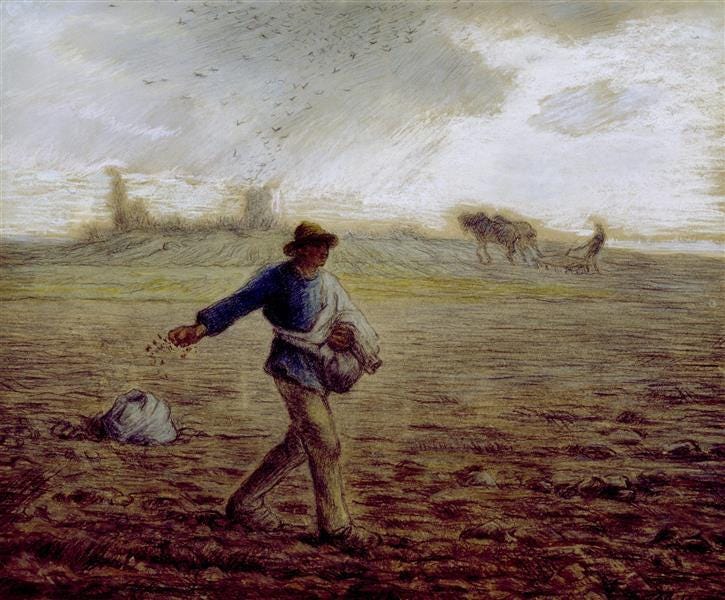
(Image: The Sower, by Jean-Francois Millet)
Modern man speaks constantly of rights, ownership, autonomy, and self-expression. We are told to “live our truth,” to “build our brand,” and to “follow our desires.” Yet beneath all of this language lies a dangerous illusion: the illusion that what we possess is truly ours.
Scripture teaches something very different.
Everything is given by God.
Not merely salvation. Not merely spiritual gifts. Everything.
Your breath is given by God.
Your mind is given by God.
Your children are given by God.
Your time, your strength, your land, your opportunities, your wealth, your influence, your vocation, your talents, and even the beating of your heart are all gifts entrusted to you by the Almighty.
We are not owners in the absolute sense. We are stewards.
This truth is woven throughout Scripture from beginning to end. Adam is placed in the garden “to tend and keep it” (Genesis 2:15, NKJV). He does not create the garden. He receives it. Israel receives the Promised Land not as conquerors by their own power, but as recipients of God’s covenantal mercy. The kings of Israel are repeatedly reminded that their authority is accountable to the Lord. Christ Himself teaches in His parables that servants will one day be called to account for what has been entrusted to them.
The Christian life is therefore not one of absolute possession, but faithful management.
This stands in sharp contrast to the spirit of the modern age.
Modern culture teaches entitlement. Christianity teaches stewardship.
Modern culture says:
“This is mine.”
Christianity says:
“This has been entrusted to me.”
That difference changes everything.
A man who believes his children are his possessions will shape them in his own image. A man who understands they are gifts from God will raise them with trembling care.
A priest who views his office as personal status becomes vain and domineering. A priest who understands himself as a steward of holy things approaches the altar with humility and fear.
A nation that sees prosperity as self-generated becomes arrogant and decadent. A nation that understands blessing as providential becomes grateful and restrained.
Even suffering looks different through the lens of stewardship. The Christian asks not merely, “Why has this happened to me?” but also, “How shall I remain faithful with what God has placed before me?”
This principle extends beyond money, though money is certainly included. Too often stewardship sermons are reduced to fundraising campaigns. But stewardship is far broader and deeper than finances alone.
You are a steward of your speech.
You are a steward of your marriage.
You are a steward of your body.
You are a steward of your reputation.
You are a steward of your mind.
And perhaps most importantly in our age, you are a steward of your attention.
Modern society is built to consume attention. Screens devour hours. Outrage consumes emotional energy. Endless distraction scatters the soul into fragments. Men and women who once built families, churches, farms, schools, and civilizations now often spend their days scrolling through triviality while their souls grow weak from neglect.
We will answer for this.
Not because God is cruel, but because stewardship carries responsibility.
Christ’s parable of the talents is sobering precisely because the servant condemned was not openly rebellious. He did not wage war against his master. He simply buried what had been entrusted to him. He refused the burden of faithful stewardship.
That temptation remains with us today.
Some bury their intellect beneath laziness.
Some bury their families beneath ambition.
Some bury their faith beneath comfort.
Some bury their gifts beneath fear.
Meanwhile others consume recklessly, assuming the gifts of God exist solely for personal gratification.
But the Christian understands that all gifts point back to the Giver.
This understanding also restores humility. A man may work hard, and he should. Scripture praises diligence. Yet even the ability to labor is itself a gift. Intelligence is a gift. Opportunity is a gift. Health is a gift. The circumstances that allowed success are gifts.
As St. Paul asks:
“And what do you have that you did not receive?” (1 Corinthians 4:7, NKJV)
The steward therefore cannot boast as though he were self-created.
Nor can he despair as though everything rests entirely upon his own shoulders.
The steward works faithfully, prays humbly, acts responsibly, and leaves the final outcome in the hands of God.
This is one of the great liberating truths of Christianity. We are called to faithfulness, not sovereignty.
God is the Owner.
We are the caretakers.
And one day each of us—rich or poor, priest or laborer, ruler or citizen—will stand before the Lord and give an account for how we handled what He placed into our hands.
May we be found faithful.
Oh, this piece is convicting when I look back! Thankfully, I am forgiven. May God grant discernment to recognize His will for my stewardship in this broken world and lead me to repentance in all the areas where I have clearly as well as unknowingly have fallen short.
Often I have heard people profess that the scripture is divinely inspired, god breathed and so on. One fire and brimstone type preacher even was aggressive about that. Something inspired the writers to write. When one is aligned with that there is a freedom or a sovereignty that comes from it that is quite different than what people think sovereignty is. I remember those preachers often would demand humility but what they were really saying was that I needed to be humble to them. Of course, my humility was placed with the same inspiration that the writers had and I would need to reject that in order to meet the demands of those preachers. But there was just no way for that to happen, so to them I was a disruption, unteachable, an even some said unclean or evil. You are correct that sometimes people assert their rights and their right to force their brand of christianity into the world but if we take a lesson from the story, Jesus hired no lawyers, offered no defence, and asserted no right of his own.