

By What Authority?

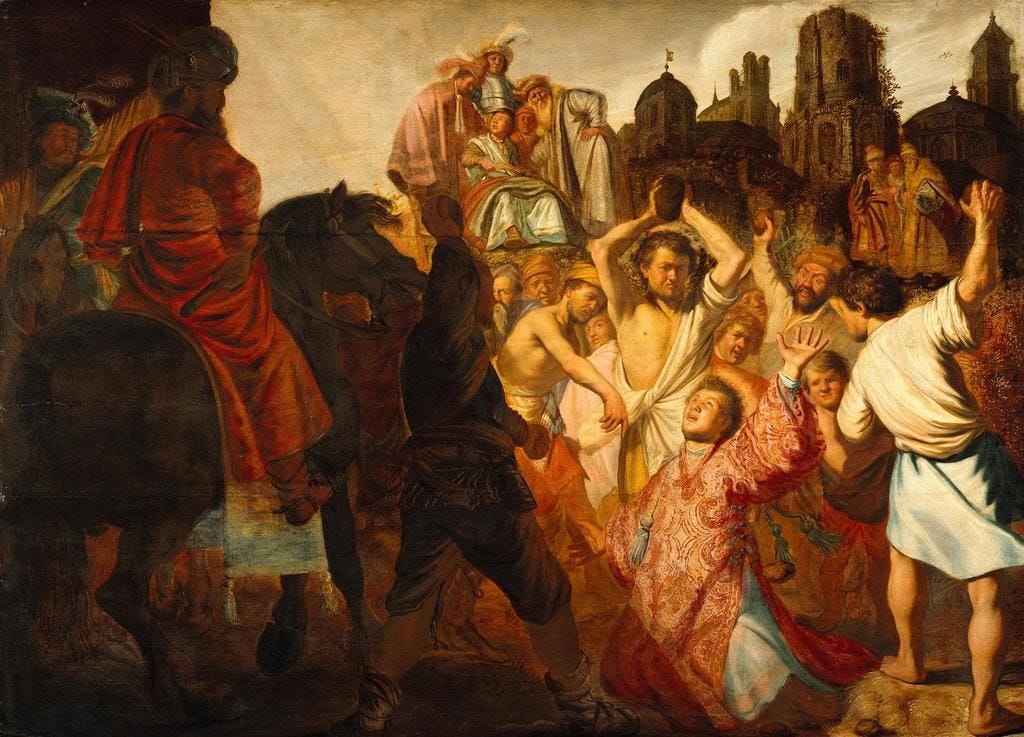
(Image: The Criticism, Rembrandt, 1625)
One of the stranger features of modern Christianity is how often believers are told what they are not allowed to do.
We are told not to speak openly about Christ in public because it might offend someone.
We are told not to quote Scripture because it might make others uncomfortable.
We are told not to wear crosses, display Christian symbols, or make our faith too visible.
We are told that religion belongs in private, hidden behind closed doors where it cannot intrude upon the public square.
What fascinates me is not merely that these demands are made.
It is that so many Christians obey them.
Before we discuss whether we should comply, we ought to ask a much simpler question:
By what authority are these commands given?
Most of the time there is no law involved.
No police officer arrives at your door because you wore a cross necklace.
No judge issues an injunction because you quoted the Gospel of John.
No statute forbids you from mentioning Christ in a conversation.
In America especially, many of the restrictions Christians imagine they face are not legal restrictions at all.
They are social restrictions.
The pressure comes from coworkers, neighbors, media personalities, academics, corporations, online commentators, and the ever-present fear of public disapproval.
In other words, we are not being commanded by Caesar.
We are being pressured by the crowd.
And the crowd has always imagined itself wiser than God.
The prophets faced it.
The apostles faced it.
The martyrs faced it.
The Church has faced it in every generation.
The faces change, but the pressure remains remarkably consistent:
“Be silent.”
“Keep your faith private.”
“Believe whatever you want, but do not bring it into public life.”
“Do not make us uncomfortable.”
Yet there is a problem with these demands.
The people making them possess influence, but they do not possess authority.
There is a difference.
A corporation may have influence.
A university may have influence.
A social movement may have influence.
A celebrity may have influence.
An online mob may have influence.
But none of them possess lordship over the conscience.
That authority belongs to God alone.
The apostles understood this distinction clearly.
When the religious authorities ordered Peter and John to stop preaching Christ, they replied:
“Whether it is right in the sight of God to listen to you more than to God, you judge.” (Acts 4:19, NKJV)
Later, when commanded again to remain silent, Peter answered:
“We ought to obey God rather than men.” (Acts 5:29, NKJV)
Notice what Peter did not say.
He did not deny that the authorities had power.
They certainly did.
They imprisoned him.
They threatened him.
Eventually many of the apostles would die for their witness.
The issue was never power.
The issue was authority.
The authorities possessed the power to punish.
They did not possess the authority to command disobedience to God.
Modern Christians would do well to recover this distinction.
Many believers today are not being threatened with imprisonment.
They are being threatened with embarrassment.
They fear being called intolerant.
They fear being called backward.
They fear being called judgmental, unenlightened, or old-fashioned.
And because human beings naturally desire approval, these accusations often prove more effective than chains.
The devil does not always need a prison cell.
Sometimes a raised eyebrow is sufficient.
The result is a strange form of self-censorship.
Christians who would never deny Christ outright often behave as though they have.
They remove the cross.
They soften the Gospel.
They avoid mentioning Jesus.
They speak endlessly about values, kindness, and community while carefully avoiding the One who gives those things meaning.
All because someone somewhere might disapprove.
Yet Christ never promised us universal approval.
In fact, He promised precisely the opposite.
“If the world hates you, you know that it hated Me before it hated you.” (John 15:18, NKJV)
The Church was never called to be popular.
The Church was called to be faithful.
Those are not always the same thing.
Indeed, they are often opposites.
The irony is that many of those who insist Christians keep their beliefs private rarely apply the same standard to themselves.
They speak publicly about politics.
They speak publicly about morality.
They speak publicly about sexuality.
They speak publicly about economics.
They speak publicly about culture.
They advocate their convictions openly and passionately.
What they object to is not public conviction.
What they object to is Christian conviction.
The dispute is not about whether beliefs should influence public life.
The dispute is about which beliefs are permitted to influence public life.
That is why Christians should learn to ask a simple question whenever someone demands silence:
“By what authority?”
Who gave you jurisdiction over my conscience?
Who appointed you guardian of what may be said about Christ?
Who granted you authority greater than the One who commanded me to proclaim the Gospel?
Usually no answer follows.
Because no answer exists.
There is only pressure.
And pressure is not authority.
The deeper issue, however, is not the world.
The deeper issue is us.
The world has always pressured Christians to compromise.
That is nothing new.
What is new is how willing many Christians have become to surrender.
We have mistaken comfort for peace.
We have mistaken acceptance for love.
We have mistaken silence for wisdom.
The first Christians possessed none of these luxuries.
Yet they transformed the world.
Not because they were powerful.
Not because they were wealthy.
Not because they were culturally approved.
But because they feared God more than they feared men.
That is the question before every generation of believers.
Whose approval matters most?
The approval of the crowd is fleeting.
Today’s applause becomes tomorrow’s condemnation.
Public opinion shifts with every season.
What was celebrated yesterday is denounced today.
The crowd is an unstable master.
Christ is not.
His commands remain.
His truth remains.
His kingdom remains.
And if He has commanded us to let our light shine before men, then no amount of social pressure can absolve us of that responsibility.
The Church does not need to become louder.
She does not need to become angry.
She does not need to become obnoxious.
She simply needs to stop asking permission to be Christian.
The next time someone tells you that your faith should remain private, ask yourself a simple question:
By what authority?
Then remember the answer given by the apostles nearly two thousand years ago:
“We ought to obey God rather than men.”
Thank you! This is a good reminder.
This is incredibly timely for me to hear. My state politics is embroiled in a bit of an uproar over a candidate that quoted an uncomfortable bit of scripture and now the usual players (even in his own party) are calling for him.to drop.out of a race and quietly disappear.