

A Year-End Confession

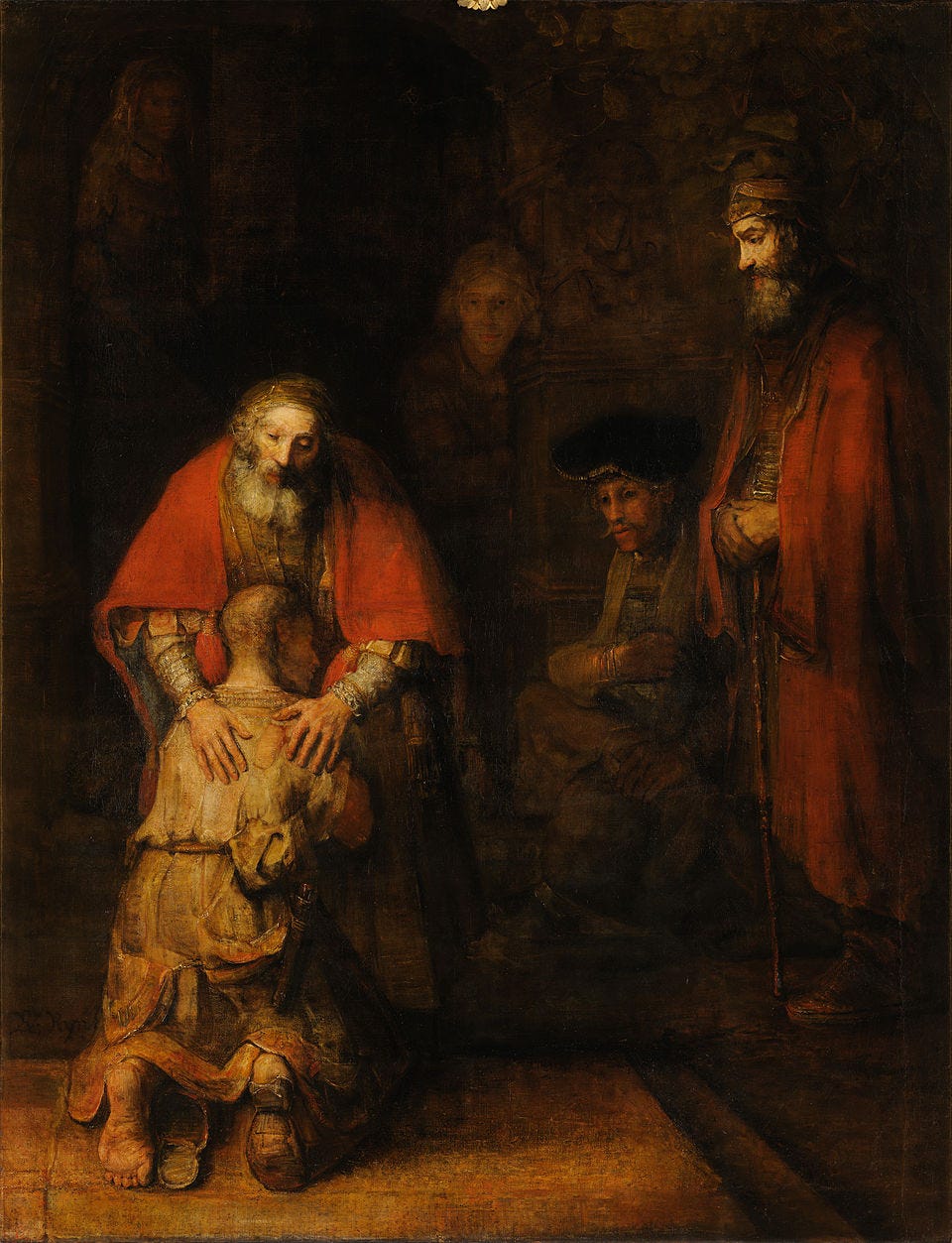
(Image: The Return of the Prodigal Son - Rembrandt)
I am a sinner.
There is no clever way to say it, no softer version that makes it easier to hear. I sin in thought, word, and deed—by what I have done and by what I have left undone. I have not loved God with my whole heart. I have not loved my neighbor as myself. I have failed in ways I recognize and in ways I do not.
I have earned the punishment of death.
If God were only just—and He is—I would have no standing, no defense, no appeal. I possess no moral capital to bargain with, no righteousness of my own to offer. I am not saved by insight, discipline, sincerity, or effort. I am saved only by mercy.
My hope rests entirely on what has been given to me by a merciful God through the sacrifice of His Son. Christ alone is my righteousness. Christ alone is my peace. Christ alone is my life.
From time to time, I hear confession. And when I do, I am acutely aware of what I am not doing.
I do not forgive sins.
I provide a place—quiet, reverent, unguarded—where someone may unburden their soul without fear or pretense. I listen. I bear witness. And then I remind them of what is true: that their sins are forgiven by the grace of God through Jesus Christ, not by me, not by my authority, not by any virtue of my office.
And as the final words before they leave, I always say the same thing:
“Go now, in peace and love—and pray for me, a sinner.”
Because I am.
The Church has long described confession this way: some should, all may, none must. Not as a loophole for avoidance, but as an invitation to honesty. Confession is not a weapon, not a performance, and not a condition of God’s mercy—but a means by which mercy is received.
Knowing all of this, a question naturally follows: how could I possibly judge someone else?
That question has become confused in our age, often weaponized to silence truth. So it must be answered carefully.
Scripture does not forbid us from naming sin. It forbids us from placing ourselves in the seat of God.
To judge a person—to pronounce upon their worth, their motives, their ultimate standing before God—is something I cannot do and must never attempt. I am not qualified for that task. I am a sinner who lives by grace alone.
But to recognize sin as sin is not judgmentalism. It is obedience.
God has spoken. He has revealed His will. He has defined good and evil. When the Church speaks against sin, she is not issuing personal opinions or moral preferences; she is bearing witness to what God has already said.
There is a crucial distinction we must recover:
We do not judge souls.
We do judge actions and teachings by the Word of God.
When I say something is sinful, I am not claiming moral superiority. I am not claiming exemption. I am not standing above anyone. I am standing under the same law, in need of the same mercy, clinging to the same Savior.
If I were silent about sin, I would not be more loving—I would be less honest. Love does not pretend wounds are harmless. Love does not bless what destroys. Love tells the truth, even when that truth implicates the speaker first.
That is why confession must always come before correction. Not as a rhetorical trick, but as a spiritual posture. We speak as forgiven sinners to other sinners, not as the righteous to the condemned.
As this year comes to a close, that is the posture we must carry with us into the next one.
We move forward not as people who have it all together, but as people who know exactly why they do not. We remember that we are no better than anyone else, no less needy, no less dependent on grace. Our calling is not to dominate, shame, or posture—but to love one another, pray for one another, and call one another back to Christ when we wander.
We speak truth because Christ is true.
We show mercy because we have received mercy.
We endure because He has endured for us.
If we keep our eyes fixed on Him—crucified, risen, reigning—then we will neither grow arrogant nor fall silent. We will walk humbly, speak clearly, repent daily, and trust completely.
I am a sinner.
And thanks be to God, Christ Jesus came into the world to save sinners.
May the Lord keep us mindful of our sin, grateful for His mercy, and steadfast in our hope.
And may Christ remain our beginning, our center, and our end.
I'm an Episcopalian who has made going to confession a spiritual discipline because it's been so incredibly good for my spiritual growth and my confessor is excellent. It's been life-changing for me and I have often suggested that people might like to try it. Some of them do, some don't, but those who do say it was so worth it.
Joh 8:15 You judge according to the flesh. I judge no one.
Shocked? I'm not.
Joh 3:17 For God didn’t send his Son into the world to judge the world, but that the world should be saved through him.
Joh 3:18 He who believes in him is not judged. He who doesn’t believe has been judged already, because he has not believed in the name of the one and only Son of God.
The religious yahshua is a scorekeeper. The real YAHSHUA is a lifeline.
The religious yahshua is waiting to condemn. The real YAHSHUA is waiting to restore. The only people YASHUA ever confronted, were the ones who thought they were qualified to judge others. Hello?
The harshest voices in the church today are often the ones furthest from the heart of the Shepherd.
What's in your heart?